
SyncastSignage (En)
SyncastSignage English PageWhat SyncastSignage Can Do
SyncastSignage eliminates the "hassle of content updates" and "placement limitations" associated with digital signage. Furthermore, by enabling "two-way information exchange" between user devices and signage, it provides a flexible and interactive information environment for both administrators and users.
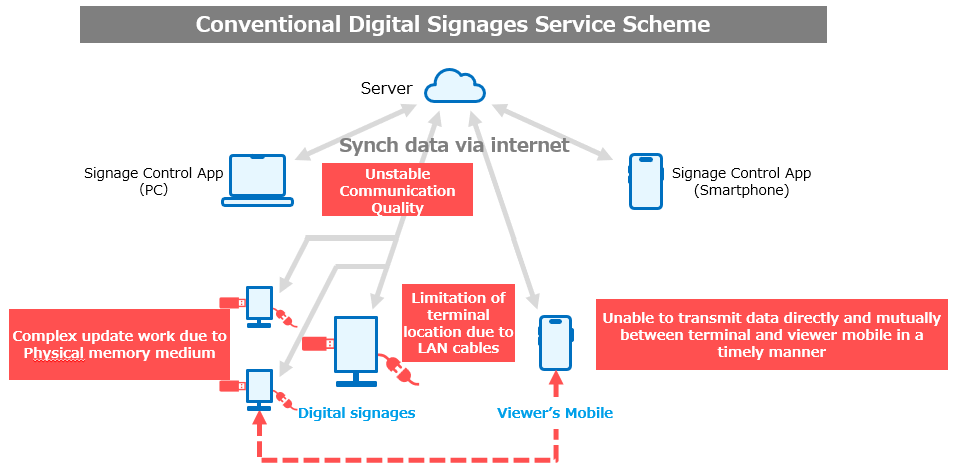
Challenges with Conventional Digital Signage
-
Complexity of Updating Information via Physical Media
- Updating information requires time and effort to insert and remove physical media such as SD cards.
- There is a risk of physical failure due to repeated insertion and removal.
-
Installation Location Limitations due to Wired LAN
- Constructing a wired LAN environment incurs construction effort and costs.
- Installation locations are physically limited by the laying of LAN cables.
-
Unstable Communication Quality
- Communication interruptions due to physical damage to LAN cables and increased communication load with more managed terminals can occur.
- There is a risk that information coordination with management terminals becomes unstable because it is impossible to transmit information to terminals located out of signal range.
-
One-way Communication
- Information is limited to a one-sided display from the signage to the user.
- It is impossible to identify user devices or acquire information from them.
Solution with SyncastSignage
The above challenges can be solved by using "SyncastSignage" as follows:
-
Achieving Wireless Updates Without Physical Media
- Updates signage display information via wireless communication without using physical media.
-
Elimination of Placement Limitations and Cost Reduction
- Eliminates the need for laying wired LAN and updates information via wireless communication between signage terminals.
-
Stabilization via Mesh Network
- Introduces a relay function (mesh network).
- Enables automatic transmission (relay) of information to nearby unreceived terminals by information receiving terminals (signage or user devices).
-
Establishment of Two-way Information Coordination
- Realizes two-way wireless communication between signage and user devices.
Service Image of SyncastSignage
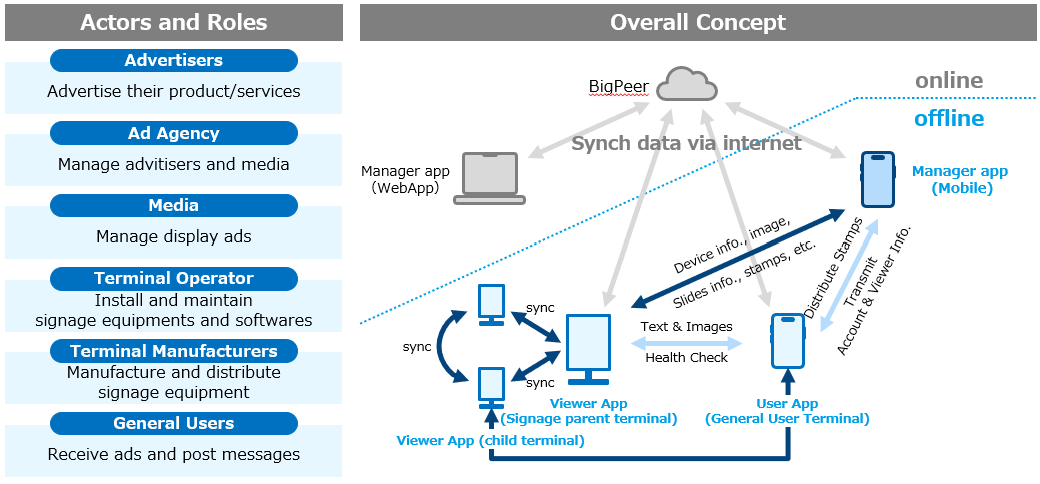
The figure above shows the overall picture of the "flexible information distribution regardless of online/offline status" and the "autonomous decentralized system centered on P2P (Peer to Peer)" provided by SyncastSignage.
1. Applications According to Roles
SyncastSignage consists of three main applications depending on use case and role.
| Application Name | Main Role | Users/Functions |
|---|---|---|
| Manager App | Registration and Management of Information | Administrators such as advertisers and media register content and configure distribution settings. |
| Viewer App | Display and Relay of Information | Terminals that perform display as signage. They synchronize information with surrounding terminals via P2P (Parent -> Child data synchronization) and display it. |
| User App | Acquisition and Coordination of Information | Installed on general users' mobile phones, etc., it links directly with Viewer terminals to realize two-way communication. |
2. Autonomous Decentralization via P2P Communication
The core of SyncastSignage lies in the direct (P2P) communication between Viewer terminals and between Viewer terminals and User terminals, enabling information synchronization and relaying.
Stable Information Display via Autonomous Decentralization
Content distributed from the Manager App is synchronized and automatically relayed not only via the internet but also between Viewer terminals. As a result, even if some terminals go offline, content is autonomously distributed and shared, maintaining stable information display across the entire system.
Operational Freedom Regardless of Installation Location
Viewer terminals and User terminals can communicate directly and synchronize content and information even in environments without internet connection (offline). This enables operation independent of communication infrastructure like wired LAN, significantly improving the freedom of installation even in locations where digital signage was previously difficult to install.
3. Two-way Communication
By using the User App, two-way communication becomes possible between signage and general user terminals, providing an interactive experience that is not one-way like traditional methods. Users can acquire and link more personal information, such as receiving advertisements or posting messages.
Overview of Use Cases for Digital Signage
Updates digital signage content and shares diagnostic information without using fixed lines or mobile phone networks.
Configuration Image for Production Operation
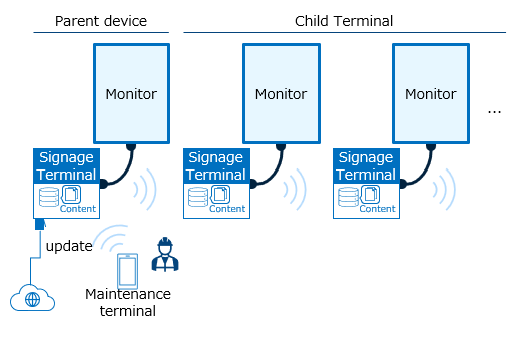
- Ads are displayed on each monitor using a combination of a signage terminal and a monitor.
- If the ads to be displayed are updated on the parent terminal, the information is automatically propagated to the child terminals.
▼ Production Operation Image Diagram
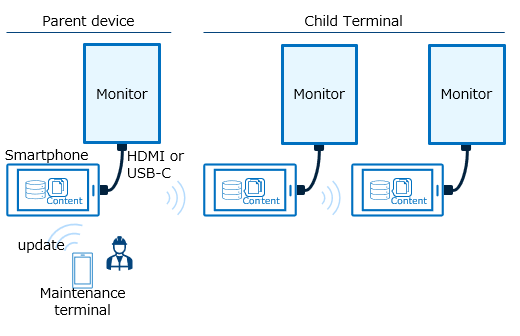
Configuration Image for Demos
- The signage terminal is a mobile phone (iPhone, etc.), and the monitor is a general PC monitor connected via HDMI or USB-C.
- Ad content contained in the mobile phone app is displayed on the monitor.
▼ Demo Configuration Image Diagram